
Inventory software, and when a clipboard is still winning
Food cost is where the margin actually goes. Software helps, but only after you know which items sell, when, and through which channel.
Trusted by food trucks, pop-ups, and independent kitchens


Do I need restaurant inventory management software?
It depends on how many ingredients you carry and how much food you throw away. Inventory software tracks counts, purchasing, waste, variance, and recipe cost, and it pays for itself quickly in a fixed kitchen with a broad menu. A truck running fifteen items off one prep list often does better with a disciplined weekly count than with another subscription. Either way, the decision it supports is prep and purchasing, and that decision needs your sales data by item, by day, and by channel.
Restaurant inventory management software
What the software actually does
Strip away the dashboards and there are five jobs underneath.
- Counts: what is on the shelf right now, and how long it has been there.
- Purchasing: what to order, from whom, and at what price, ideally against par levels.
- Waste: what got thrown out, and why, which is usually the most uncomfortable and most useful report.
- Variance: the gap between what you should have used, based on sales, and what you actually used.
- Recipe and menu costing: what each plate costs you, which tells you which items are worth promoting.
When it pays for itself
A fixed kitchen with fifty-plus ingredients, several suppliers, and a broad menu will usually see the subscription back in reduced waste inside a season. Add multiple locations, or a menu that changes weekly, and the case gets stronger. High-value proteins make variance tracking pay on its own.
When a clipboard is still competitive
One truck, fifteen items, one prep list, one shopping run. The counting still has to happen, but a shared sheet and a habit will get you most of the benefit without another login for your team to forget. The failure mode here is not the lack of software, it is the lack of a consistent count on the same day every week.
Start with demand, not with counting
Inventory answers what you have. Your sales data answers what you will need, and that is the harder half. Look at the last four weeks by item and by day, and split it by channel: your direct orders, walk-ups, catering, and anything coming through a marketplace behave differently. Preorders and event menus are the most useful data of all, because those are the orders you already have before you buy the food.
The habits that matter more than the tool
Most of the gain here is process, and process does not come in a box.
- Count on the same day, at the same time, with the same person.
- Write down waste as it happens, not from memory at the end of the week.
- Price your top ten items properly and check them against invoices every quarter.
- Use preorder and catering numbers to buy ahead instead of guessing.
- Cut the three items that sell least and cost the most to keep stocked.
Before you buy inventory software
If you cannot answer the first four from your current tools, fix that before adding another subscription.
- 01What are my top ten items by volume, over the last four weeks?
- 02What does each of those cost me to make, with today's invoice prices?
- 03How much food did I throw out last week, and what was it?
- 04How does demand differ between a market day, a normal Tuesday, and a catering week?
- 05Who on my team will do the count, and when?
- 06Does the tool import my sales data, and in what format?
- 07What does it cost per month against the waste I can actually measure?
Where Outbites fits
Outbites is not inventory software and does not pretend to be. What it gives you is the demand half of the problem, which is what most purchasing decisions are actually missing.
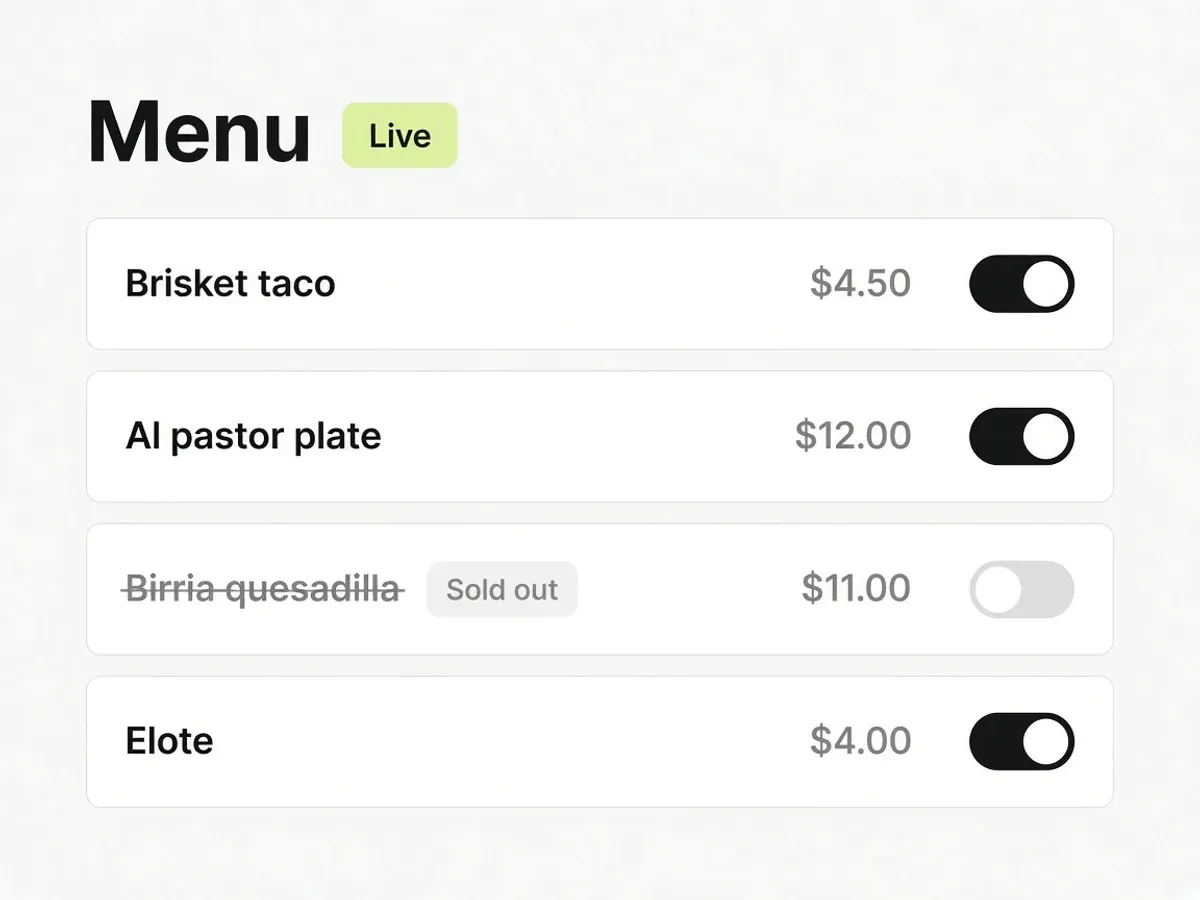
- Sales reporting by item and by day, so you can see what to prep.
- Orders split by channel, including catering and event menus.
- Preorders and menu drops, which are demand you have already collected before you buy the food.
- Sold-out and paused states, so the menu never promises something the walk-in cannot deliver.
- Not included: counts, par levels, purchase orders, supplier pricing, or recipe costing. Use a dedicated tool for those.
Frequently asked questions
What operators ask us about restaurant inventory management software.
What are the benefits of inventory software in a restaurant?
It reduces waste, tracks food cost against real invoice prices, improves purchasing, prevents running out mid-service, and shows which menu items actually protect your margin. The gains are largest in a fixed kitchen with many ingredients and several suppliers.
Is Outbites inventory management software?
No. Outbites is a direct ordering, point of sale, and retention platform. It covers sales reporting by item and channel, sold-out and paused states, preorders, and catering, which help you prep and purchase. It does not do counts, par levels, purchase orders, or recipe costing, and you should use a dedicated tool for those.
How does online ordering affect inventory?
It changes the shape of demand. Direct orders, marketplace orders, QR orders at the window, catering, and event preorders all peak at different times and skew to different items. Break your sales down by channel before you set par levels, or you will keep buying for an average day that never actually happens.
Should inventory software integrate with my POS?
Usually yes, because sales data is what turns a count into a forecast. Confirm the specifics before you buy: how item movement is mapped, how modifiers and recipes are handled, how often it syncs, and who supports the connection when it breaks.
Food businesses taking orders on their own link
Named Austin kitchens, in their own words.
“This is the first stack that actually moved the needle on direct online revenue.”
Aisha B.
“Less money lost to middlemen and a lot more orders coming straight to us.”
Renee J.
“Branded ordering on our own site. Guests notice and the average ticket keeps climbing.”
Grace C.
“Service runs tighter. Fewer fire drills on the line and fewer missed calls up front.”
Andre Z.
“We keep the full ticket on pickup, and delivery costs stay small and predictable.”
Maya V.
“We close late. I have never waited long for a real person when something breaks.”
Luis O.
“We are steering volume off third-party marketplaces and putting dollars back in-house.”
Chris D.
“It helps independents stand next to the chains without a seven-figure tech budget.”
Tara E.
“Setup was painless. Online sales picked up faster than we budgeted for.”
James W.
“Orders go out smoothly and our promos are finally getting real traction.”
Elena R.
“We outgrew our old DIY site. Web sales are up well over half year over year.”
Ben Y.
“Our site finally matches the restaurant, and someone walked us through every tweak.”
Sofia M.
“I'm a vampire. The truck only parks after dark, garlic is off the menu, and guests still order from the QR on the window.”
Lenore V.
Reading is cheaper than switching. Trying is cheaper than both.
Create an account, add one item, and take a test order on your own phone before you commit to anything.
- $1 per fulfilled order
- No monthly platform fee
- We never hold your payouts
- Cancel anytime